






Market Size & Scope
- Listings: At their peak pre-COVID, Australia had around 330,000 short-term rental listings. As of December 2023, listings dropped about 15 % to 278,788, with roughly 69 % active users (booked at least once per month).
- Platform Composition: Airbnb holds the majority share—130,000+ listings, compared to 40,000+ on Stayz/HomeAway (as of 2018). Many hosts list across both platforms, so figures overlap.
Short term rentals comprise 1–2 % of Australia’s 11 million dwellings which still approximately 200,000 properties at the higher end of that range.
Impact on Housing Affordability & Supply
- National level: Independent research by Urbis (commissioned by Airbnb) concluded that short term rentals have no consistent impact on national rental affordability trends, given their small share of housing stock (1–2 %).
- Localised hotspots: In tourist areas like Byron Bay, Gold Coast, Sunshine Coast, and Hobart, short term rentals represent up to 15 % or more of dwellings. There, they clearly reduce supply of long term housing and push up rents.
Rental affordability is influenced more by structural factors such as low vacancy rates, rising interest rates, limited new housing stock, and investor demand—not just STR listings.
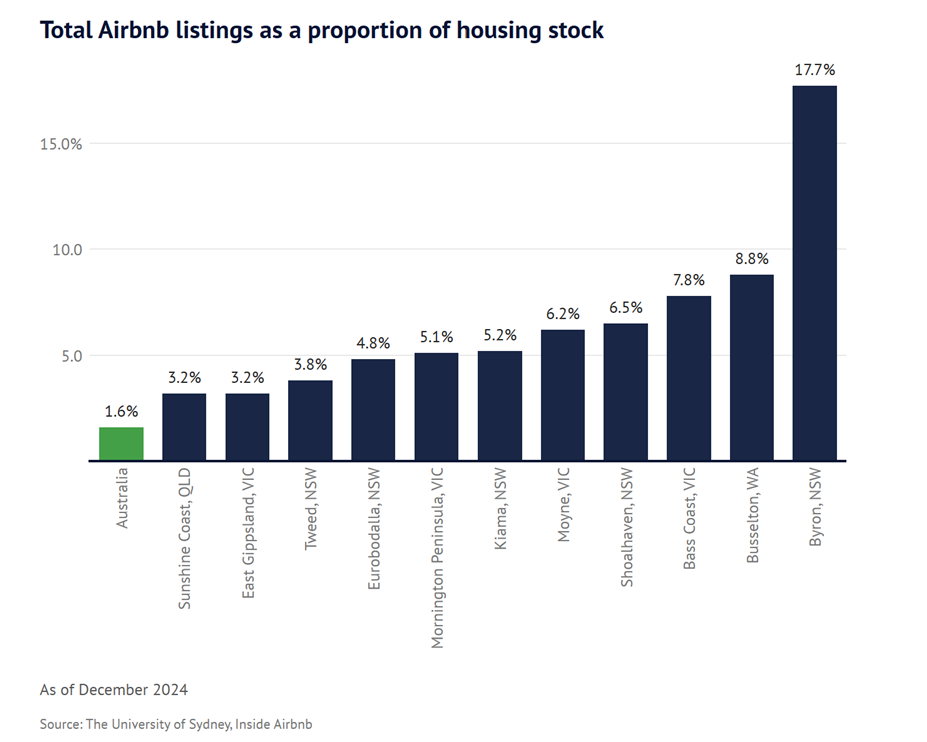
Example: University of Sydney studies observed imminent rent increases in parts of Sydney where Airbnb activity was concentrated.
Investment Behaviour & Residential Property Pricing
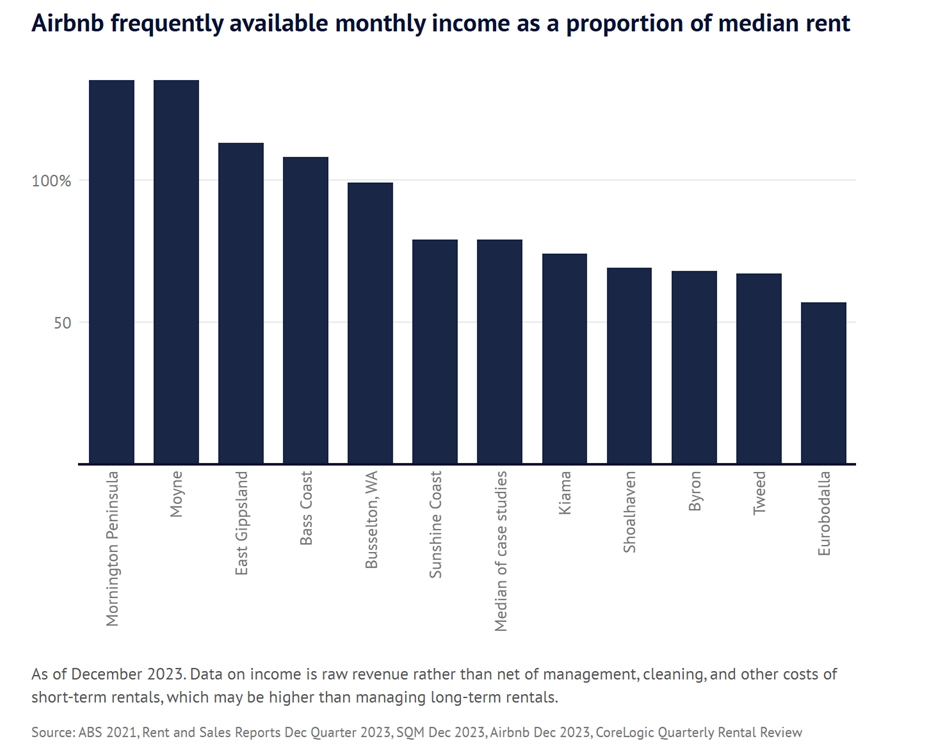
Investors are reportedly paying 2–3 % premiums for investment properties with an existing short term rental track record, betting on higher yield over long term leasing.
Regulatory Responses by State & Local Governments
Australia is responding with a patchwork of regulations to rebalance STR vs long-term housing:
Australia is responding with a patchwork of regulations to rebalance STR vs long-term housing:
- New South Wales: 180 day annual cap on unhosted rentals in Greater Sydney and select regional LGAs; 60 day cap in Byron Shire from September 2024. Mandatory registration also applies.
- Victoria: 7.5 % consumer levy on short-stay bookings from Jan 2025, with funds directed to social housing. Body corporates may ban STRs with 75 % vote, and councils can opt into area bans.
- Western Australia: Required state-wide registration by Jan 2025; unhosted STRs capped at 90 nights in metro Perth; owners can receive a A$10,000 incentive for switching to long-term leasing.
- Queensland: Local councils applying rate surcharges, approvals, and approval renewals for STR operators. State-level register under consideration.
- Tasmania: A proposed 5 % levy on short-term rentals to fund first-home buyer support; tighter restrictions in some local areas are under discussion.
Competing Perspectives & Economic Effects
- Tourism & economy: Airbnb reports $13.6 billion in GDP impact and nearly 95,000 jobs supported in year to March 2023—representing 8 % of Australia’s tourism GDP and guest spending of $12.3 billion.
- Airbnb’s position: Airbnb execs argue STRs serve many lower-income hosts, make up a small proportion of housing stock, and represent mostly shared or holiday home listings which may not have entered the long term rental market anyway.
Looking Ahead
- Stronger regulation is likely to spread across remaining states and councils.
- Levy schemes, night caps, and enforced registration systems may encourage some hosts to shift properties back into long term rentals.
- Holistic housing policy—focused on increasing supply, social housing, and build to rent developments—will be necessary to mitigate rental pressures broadly.
- Investor behaviour may shift as returns from traditional long term leasing rise and regulatory costs weigh on short term yield.
Regulatory responses in several states now aim to rebalance the ecosystem, and future policy is likely to continue focusing on redirecting some STR stock back into long term rentals, while preserving tourism-related income. Still, STRs alone aren’t the root of Australia’s rental crisis—it’s part of a larger systemic set of housing supply, finance, and planning issues.
Get clarity and confidence before you buy
Looking to make sense of how shifting regulations and rental trends could shape your next investment move? As Buyer’s Agents, we help you navigate Australia’s evolving property landscape—from holiday‑home potential to long‑term rental opportunities.
Book a property strategy chat with our team today and unlock the data behind smart investing.